Temple of Heaven
天坛 · Tiāntán
The most perfect building in Beijing, and a park full of retirees doing tai chi, ballroom dancing and competitive kite-flying.
Photo: Shujianyang · CC BY-SA 4.0 · resized
Built in 1420 alongside the Forbidden City, the Temple of Heaven was where the emperor — as Son of Heaven — performed the winter solstice sacrifice that guaranteed the coming year's harvest. The whole 267-hectare complex is a diagram of Chinese cosmology: square outer walls for earth, round inner structures for heaven, everything laid out in multiples of nine, the imperial number.
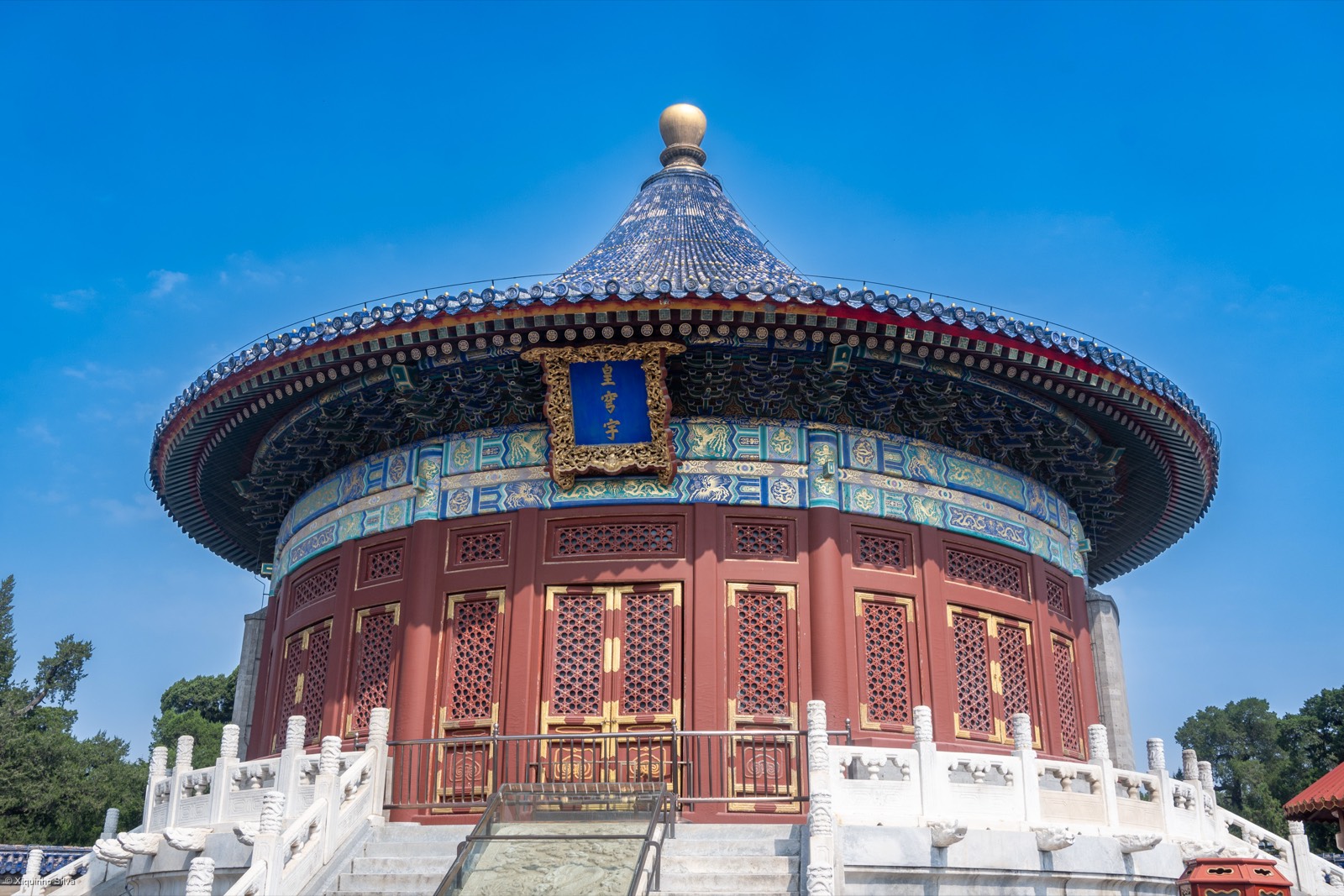
The Hall of Prayer for Good Harvests is the payoff, and it is genuinely one of the great buildings of the world: 38 metres of triple-eaved cobalt-tiled roof on a three-tier marble platform, built entirely without nails, held up by 28 pillars — four for the seasons, twelve for the months, twelve for the two-hour periods of the day. It burned down after a lightning strike in 1889 and was rebuilt to the original specification.
What makes the visit better than a straight monument tour is the park around it. Beijing's retired population has colonised the covered walkways since the 1980s: card schools, erhu players, a large and serious ballroom-dancing contingent, choirs, and people flying kites so high you lose them against the sky. Come at 07:00 and you see a version of the city that has nothing to do with tourism.
Why go
- Architecturally the most refined thing the Ming built, and unusually easy to photograph
- The morning park culture is one of Beijing's genuine, unstaged pleasures
- Far less crowded than the Forbidden City and a fraction of the ticket price
- The acoustic tricks — Echo Wall, Triple-Sound Stones — are silly and delightful
Highlights
Hall of Prayer for Good Harvests
The circular blue-roofed hall on its marble terrace. Go early for clean light and empty steps.
Imperial Vault of Heaven & Echo Wall
A smaller round hall ringed by a wall that carries a whisper the full 65-metre circumference — when there is no crowd shouting into it.
Circular Mound Altar
Three bare marble tiers, no building. Stand on the centre stone and your own voice comes back amplified. This is where the actual sacrifice happened.
The Long Corridor
A 350-metre covered walkway that is the social heart of the morning park. Cards, chess, singing, and the occasional accordion.
Cypress grove
Over 3,500 ancient cypresses, some 600 years old, including the gnarled Nine-Dragon Cypress near the west gate.
Photographs
Getting there & practicalities
Getting there
Metro Line 5 to Tiantan Dongmen (East Gate), which puts you closest to the main buildings. Line 8 to Tianqiao for the west side.
Tickets
Park entry ¥15 (¥10 winter); the through-ticket including all three main buildings is ¥34 (¥28 winter). Buy at the gate or on WeChat.
Opening hours
Park 06:00–22:00; the monuments 08:00–17:30 in summer, 08:00–17:00 in winter.
Best time of day
07:00–09:00 for the park culture and the light. The monuments open at 08:00.
What everyone gets wrong
- Buy the through-ticket, not park-only — the park alone is not the point.
- Enter east and leave south, then walk to Qianmen and the Dashilan hutong for lunch.
- The Echo Wall only works when it is quiet, which means before 09:00 on a weekday.
- Bring a wide lens; the Hall of Prayer is hard to fit in frame from the terrace.
What to eat
- Dashilan and Qianmen, twenty minutes north, for old Beijing snacks — try the fried liver at Tianxingju
- The Hongqiao Pearl Market food court opposite the east gate is better than it sounds
→Combine it with