Changbai Mountain
长白山 · Chángbái Shān
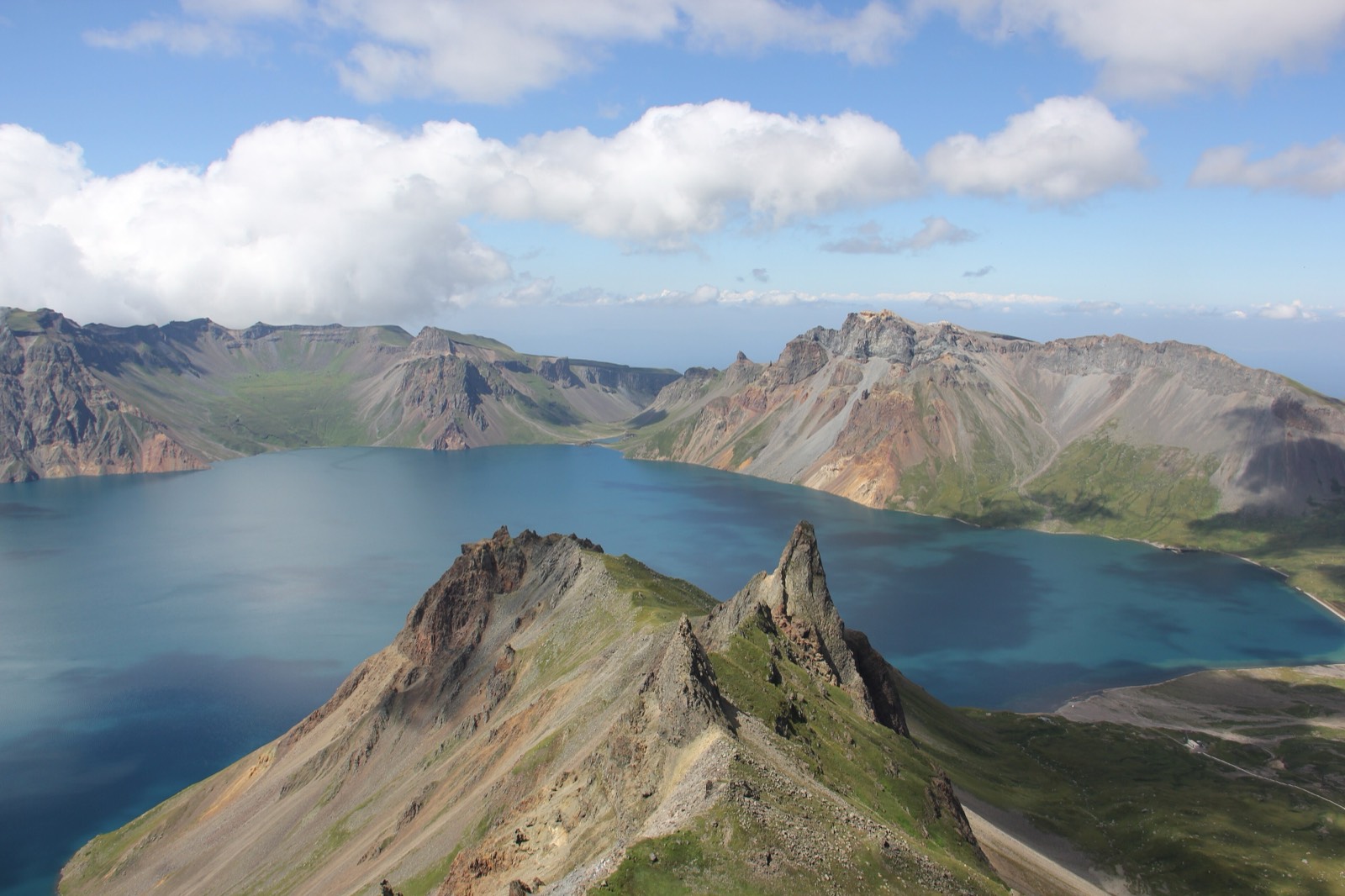
A crater lake of impossible blue in a volcano on the North Korean border, sacred to Manchus and Koreans alike.
Photo: Laika ac from USA · CC BY-SA 2.0 · resized
Changbai Shan — Paektu in Korean — is a stratovolcano straddling the China–DPRK border, and its eruption around 946 AD was one of the largest of the last two millennia, ejecting an estimated 100 km³ of material and leaving a caldera 5 km across. That caldera filled with water. Heaven Lake sits at 2,189 metres, is 373 metres deep, and is a blue so intense that first-time visitors assume the photographs are manipulated.
The mountain is sacred twice over: it is the mythic origin place of the Manchu people who founded the Qing dynasty, and it holds an even more central place in Korean national mythology on both sides of the DMZ. The border runs straight across the lake, and from the Chinese rim you are looking at North Korea.
The catch is weather. The summit is clouded or fogged for a large majority of the year, and there is a well-worn statistic that visitors have roughly a one-in-three chance of seeing the lake at all. July to September gives the best odds and the wildflower meadows on the lower slopes; winter turns the whole mountain into a ski and hot-spring destination with the lake frozen and often visible in the clearer, colder air. Either way, build in more than one day.
Why go
- One of the most striking single sights in China, when the cloud lifts
- A genuine volcanic landscape — hot springs, a 68 m waterfall, lava fields
- Wangqing and Yanji nearby have a large Korean-Chinese population and outstanding food
- Winter skiing and open-air hot springs at −20°C
Highlights
Heaven Lake (Tianchi)
The caldera lake, reached from the North, West or South slope. The North slope uses minibuses up a switchback road; the West slope has 1,442 steps.
Changbai Waterfall
68 m, the lake's only outlet and the source of the Songhua River. Reachable on foot from the North slope base and impressive year-round.
Underground Forest
A collapsed volcanic fissure with old-growth forest growing inside it, 60 m below the surrounding plateau. An easy, beautiful walk.
Hot springs
Volcanic springs at up to 82°C beside the waterfall trail — hot enough that vendors boil eggs in them. Several resorts have open-air pools.
Yanji & Korean culture
The Yanbian Korean Autonomous Prefecture, with bilingual signage, cold noodles and dog-free Korean-Chinese barbecue that is among the best food in the northeast.
Photographs
Getting there & practicalities
Getting there
Changbaishan airport is 20 minutes from the West slope with flights from Beijing, Shanghai and Shenyang. High-speed rail runs to Baihe (Erdaobaihe) town, the North slope base, from Shenyang and Changchun in 4–5h.
Tickets
Park entry ¥105 plus ¥85 for the compulsory shuttle. The summit minibus on the North slope is a further ¥80. West slope is similar.
Opening hours
Gates open around 06:30–07:00 and the summit road closes early in bad weather.
Best time of day
July–September for the best chance of clear skies and alpine flowers; January–February for snow and hot springs.
What everyone gets wrong
- Give yourself two attempts at the summit. One-day visitors who get cloud go home with nothing.
- The summit road closes for wind at short notice. Check at the gate before buying the summit shuttle.
- It is 15–20°C colder at the rim than at the base, in any season, with high wind. Take a proper jacket in August.
- North slope has the waterfall and springs; West slope has the meadows and the staircase. If you only do one, North.
- You are on an international border. Do not cross the marked lines at the rim, and drones are prohibited.
What to eat
- Korean-Chinese cold noodles (naengmyeon) and barbecue in Yanji or Erdaobaihe
- Wild ginseng, pine mushrooms and frog stew — regional specialities of the Changbai forests
→Combine it with