Harbin Ice Festival
哈尔滨冰雪大世界 · Hā'ěrbīn Bīngxuě
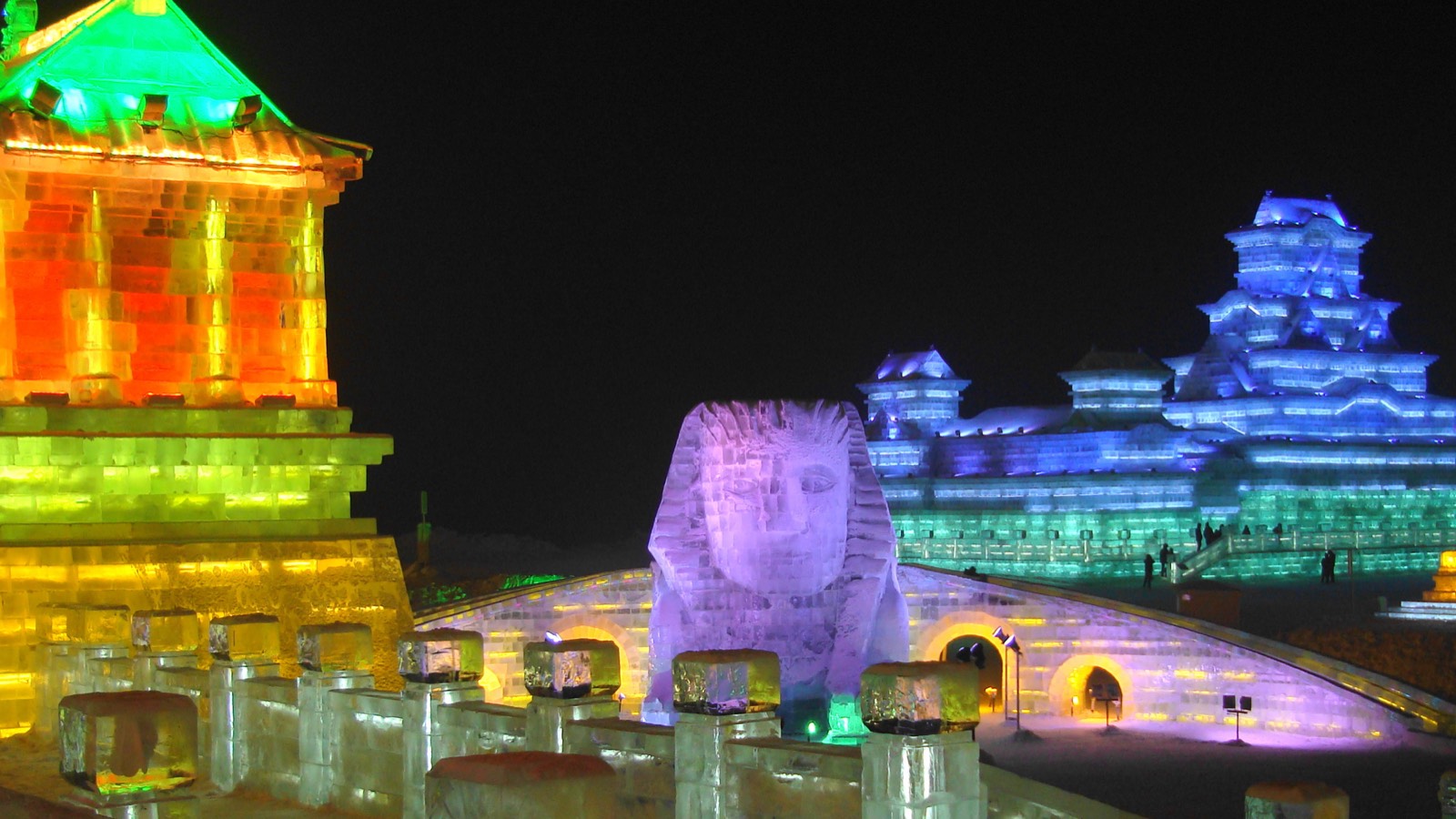
A city of illuminated ice, cut from a frozen river in blocks and rebuilt every winter at −25°C.
Photo: Dayou_X · CC BY-SA 2.0 · resized
Harbin was founded as a Russian railway town in 1898 — the junction of the Chinese Eastern Railway — and for decades had a large Russian, then White Russian émigré, then Jewish population. The legacy is a downtown of onion domes, Art Nouveau facades and a cobbled pedestrian street, Zhongyang Dajie, that looks nothing like the rest of China. St Sophia Cathedral, red brick with a green dome, is the emblem.
The other legacy is the cold. Harbin sits at 45°N with a continental climate that produces January averages around −19°C and regular nights below −30°C. In the 1960s the city turned this into an ice-lantern tradition, and since 1999 into the Harbin Ice and Snow World: a temporary city of buildings, towers, slides and replica monuments cut from Songhua River ice in blocks up to a cubic metre, assembled into structures many storeys high, and lit from inside with colour-changing LEDs.
It is genuinely spectacular and genuinely brutal. You will be outdoors, at night, at −25°C, for three or four hours. Chinese visitors go dressed like polar explorers and they are right to. Get that part correct and it is one of the most memorable nights in this guide; get it wrong and you will last forty minutes.
Why go
- The largest ice festival in the world, and the scale is far beyond what photographs convey
- Russian-influenced architecture unlike anywhere else in China
- Yabuli and Chongli have made China a legitimate ski destination since the 2022 Olympics
- Winter is China's cheapest and least crowded travel season — except here
Highlights
Ice and Snow World
The main site on Sun Island: full-scale ice buildings, a 300 m ice slide, and LED lighting throughout. Opens around 11:00 but only worth it after dark, from 17:00.
Sun Island Snow Sculpture Expo
The daytime counterpart — enormous carved snow sculptures, some 30 m long, in white rather than coloured ice.
Zhaolin Park ice lanterns
The original, smaller, older tradition — hand-carved ice lanterns in a city park. More intimate and much cheaper.
St Sophia Cathedral & Zhongyang Dajie
A 1907 Russian Orthodox cathedral and a 1.4 km cobbled street of Art Nouveau buildings. Walk it with a Modern ice cream, which locals eat outdoors in January.
Songhua River
The river freezes solid enough to drive on. Ice sledges, horse carts and a great deal of improvised fun.
Yabuli & Chongli
Yabuli, 3h east, is China's largest ski resort; Chongli, near Beijing, inherited the 2022 Olympic pistes and is 50 minutes from the capital by rail.
Photographs
Getting there & practicalities
Getting there
Harbin West station: 8h from Beijing by high-speed rail, or a 2h flight. Taiping airport is 40 minutes from downtown. The metro connects the station to Zhongyang Dajie.
Tickets
Ice and Snow World ¥328–398 depending on date, with cheaper daytime entry. Snow Sculpture Expo ¥240. Zhaolin Park ¥150. Book online; peak nights sell out.
Opening hours
Ice and Snow World roughly 11:00–21:30, and it only comes alive after dark.
Best time of day
Late December to late February. The festival officially opens 5 January but the park runs from around Christmas.
What everyone gets wrong
- Dress properly: thermal base layer, fleece, down parka, snow trousers, insulated boots, balaclava, two pairs of gloves. This is not overkill at −25°C.
- Phone batteries die in minutes. Keep the phone against your body and carry a power bank, also kept warm.
- Cameras fog badly when brought inside. Put the camera in a sealed bag before you go indoors and let it warm up slowly.
- Buy the evening ticket, arrive at 16:30 for blue hour, and plan warming breaks — there are heated indoor pods inside the park.
- Hotel prices in Harbin triple during the festival. Book months ahead.
What to eat
- Guo bao rou — sweet-and-sour fried pork, invented here for Russian palates
- Harbin red sausage and Russian-style rye bread (dalieba); Harbin beer, China's oldest brewery
- Dongbei stews: pork with cabbage and glass noodles, and the enormous 'iron pot' fish
→Combine it with