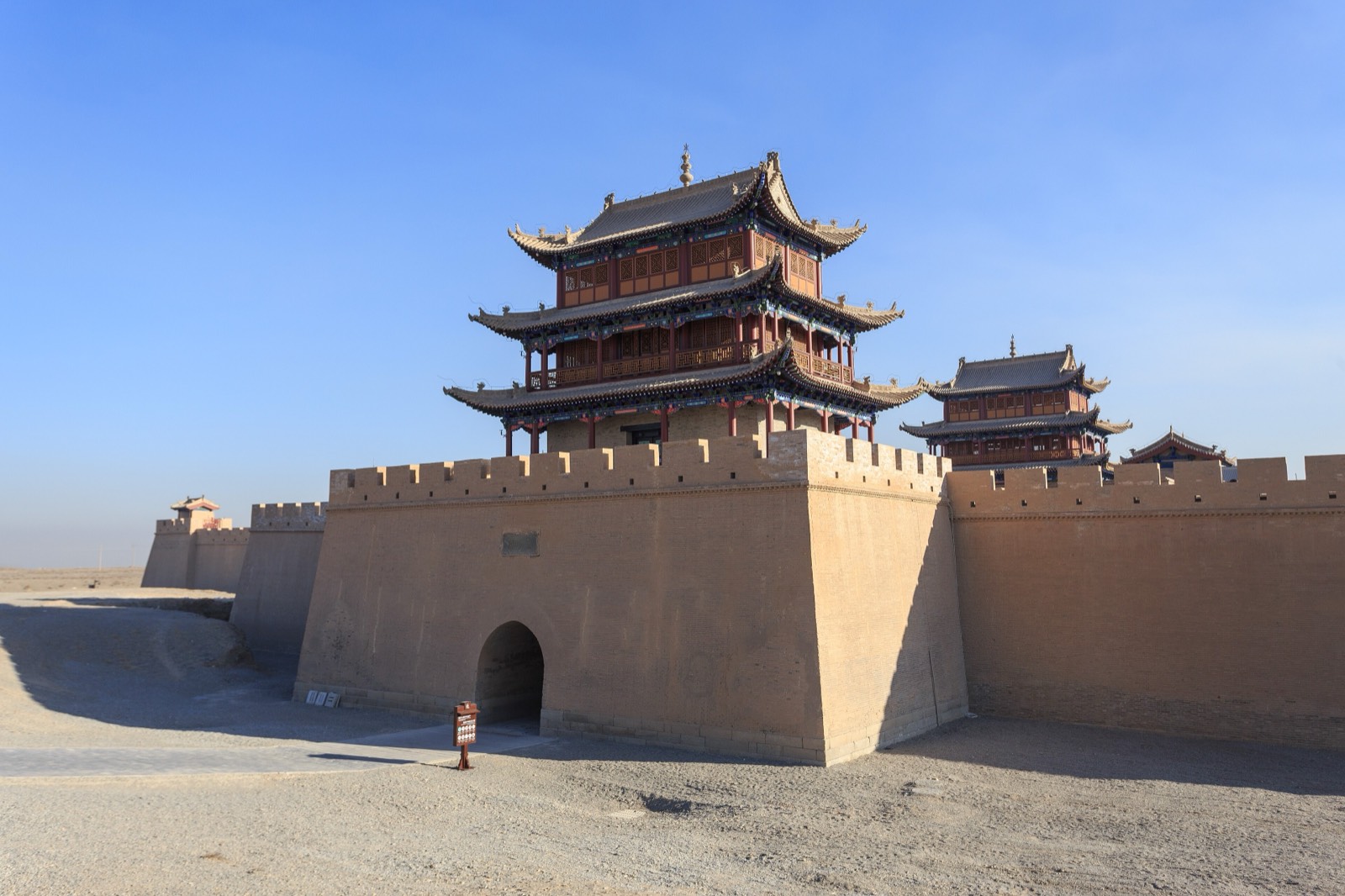
Jiayuguan Fort
嘉峪关 · Jiāyùguān
Where the Great Wall ends: a Ming fortress in the desert, between a snow range and the Gobi, that marked the edge of the civilised world.
Photo: Zhangzhugang · CC BY-SA 4.0 · resized
The Hexi Corridor narrows to a 15-kilometre gap between the Qilian Mountains and the Mazong range, and in 1372 the Ming built a fort in that gap. Jiayuguan was the western terminus of the Ming Great Wall and the last garrison of the empire — beyond it was 'outside the pass', a phrase that in Chinese carries the full weight of exile. Officials banished west were escorted through the gate and it was closed behind them.
The fort is well preserved and startlingly complete: an inner citadel with three-tiered gate towers, an outer wall, a moat, barracks, a temple and a theatre stage for the garrison, all in rammed earth and grey brick against a backdrop of snow peaks. There is a well-known story about the fort's designer, who calculated the brick requirement so precisely that a single spare brick was left over; it sits on a ledge above the Huiji Gate and no one has moved it in 650 years.
Two nearby fragments complete the picture. The Overhanging Great Wall climbs a bare ridge at a punishing angle, a 750-metre restored section that gives you the classic wall-in-the-desert photograph. And the First Beacon Tower stands on a cliff above the Taolai River gorge — the literal end of the wall, a crumbling stub of Ming rammed earth with a 56-metre drop below it.
Why go
- The most complete Ming fortress in China, and the western full stop of the Great Wall
- A landscape of snow mountains and desert that is worth the stop by itself
- Wei-Jin tomb murals nearby: 1,700-year-old painted brick that reads like a comic strip
- One hour from Zhangye, two from Dunhuang, on the same rail line
Highlights
The fort
Inner and outer citadels, three gate towers, the garrison theatre and the famous extra brick. Allow two hours.
Overhanging Great Wall
8 km northwest: a steep restored section climbing a bare black ridge, with the Gobi on one side and the Qilian snows on the other.
First Beacon Tower
The actual western end of the wall, on the lip of the Taolai gorge. A glass-floored viewing platform lets you look straight down.
Wei-Jin Tombs
20 km out: underground brick tombs from 220–420 AD, with a single painted brick per course showing farming, hunting, cooking and banqueting. One tomb is open and it is remarkable.
July Glacier
A 4,300 m glacier in the Qilian range, 120 km south — a long day trip, and one of the few glaciers in China with vehicle access to the trailhead.
Photographs
Getting there & practicalities
Getting there
Jiayuguan South station on the high-speed line: 2h from Zhangye, 2h from Dunhuang, 4h30 from Lanzhou. There is also a small airport. The fort is 6 km from town.
Tickets
A ¥110 combined ticket covers the fort, the Overhanging Wall and the First Beacon Tower, valid two days. Wei-Jin Tombs ¥31.
Opening hours
08:30–20:00 May–October; 08:30–18:00 in winter.
Best time of day
Late afternoon for the fort — the low sun on the rammed earth against the snow peaks is the image.
What everyone gets wrong
- The three sites are 8–20 km apart with no useful bus. Hire a taxi for a half day (¥150–200) or a driver for the full circuit.
- The Overhanging Wall is a short but genuinely steep climb at 1,700 m altitude. It will take more out of you than it looks.
- The Wei-Jin tomb is dark, cramped and requires a torch, and photography is banned. It is also the most interesting thing in the area.
- Sandstorms hit in spring and can close the outdoor sites entirely.
- One night is enough. Do it as a stop between Zhangye and Dunhuang.
What to eat
- Lanzhou-style hand-pulled beef noodles, which in Gansu are a breakfast
- Grilled whole lamb ribs and Gobi mushroom dishes
→Combine it with
Nearby and next
 UNESCO
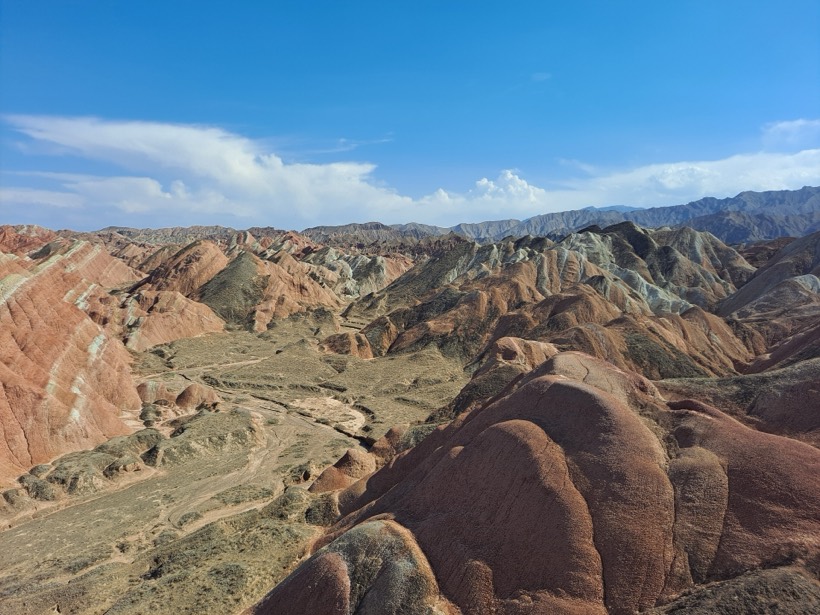
Zhangye Danxia 张掖丹霞
Hills striped in red, orange, yellow and green — twenty-four million years of mineral sediment tilted on its side.
 UNESCO
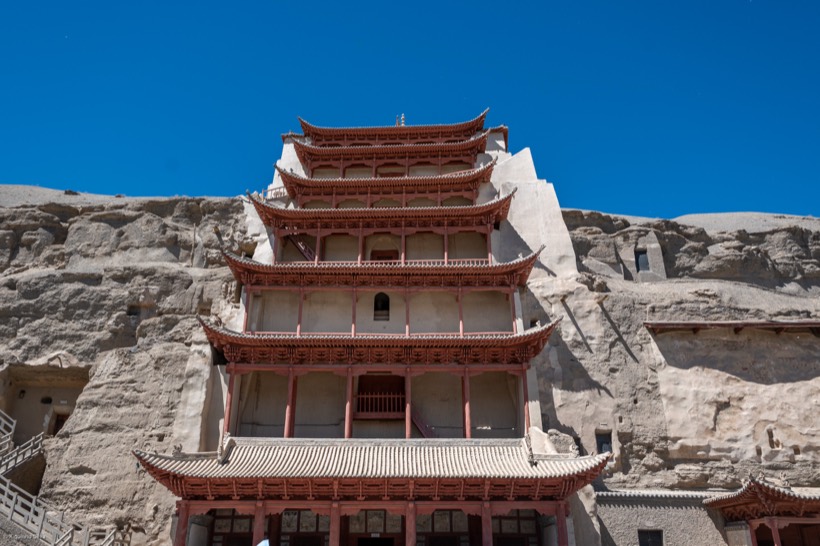
Mogao Caves & Dunhuang 莫高窟与敦煌
Four hundred and ninety-two painted caves in a desert cliff — a thousand years of Buddhist art, sealed and forgotten for nine centuries.