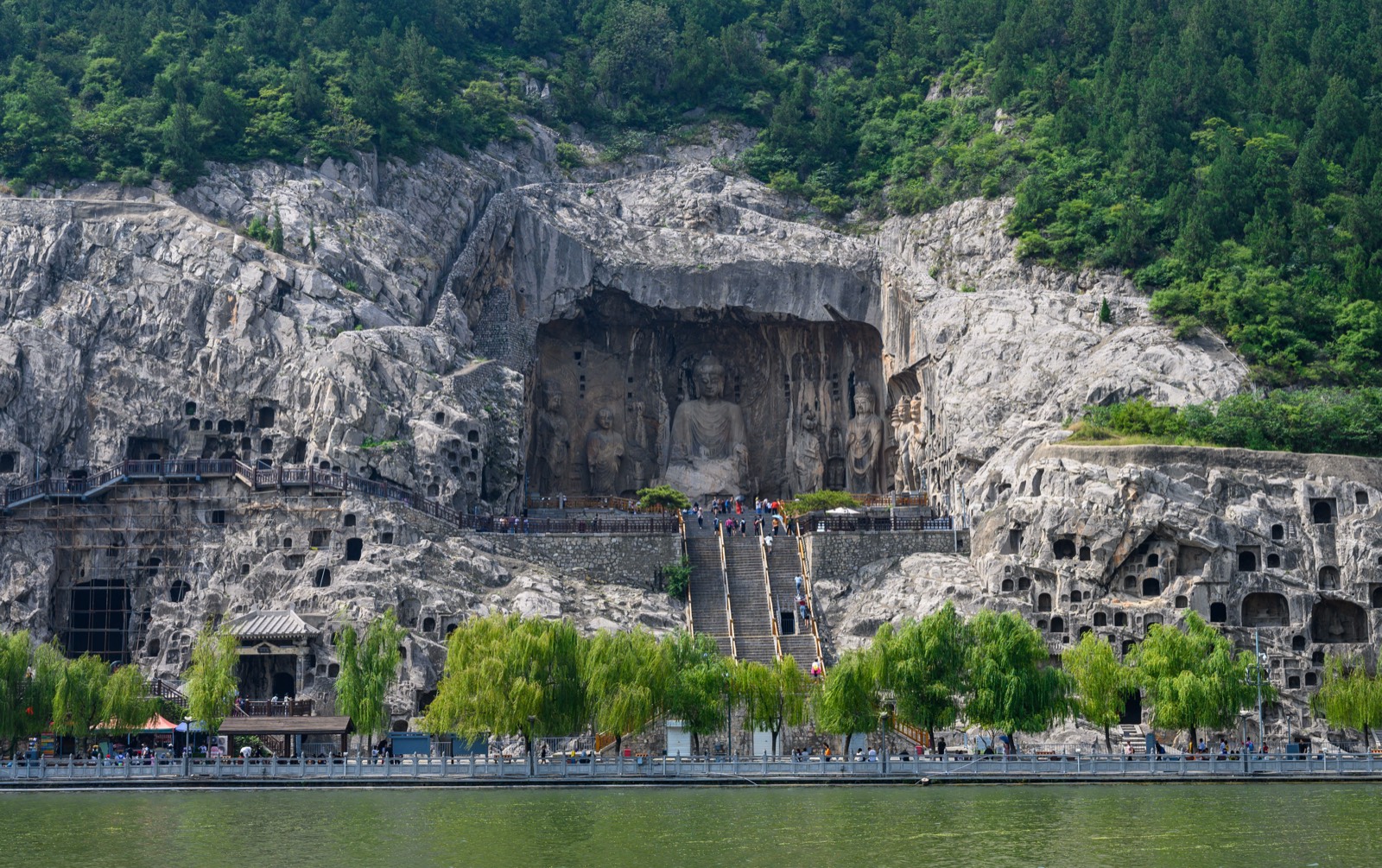
Longmen Grottoes
龙门石窟 · Lóngmén Shíkū
A hundred thousand Buddhas carved into two limestone cliffs facing each other across a river — including the one with Empress Wu's face.
Photo: xiquinhosilva · CC BY 2.0 · resized
When the Northern Wei moved their capital south to Luoyang in 493 they brought their cave-carving habit with them, and kept going for four hundred years. Longmen has 2,345 niches, 100,000 statues and 2,800 inscriptions cut into the limestone gorge where the Yi River breaks through the hills. It is the largest and, in its finest work, the most technically accomplished of China's Buddhist cave sites.
The masterpiece is Fengxian Temple, carved in the 670s under Tang imperial patronage. The central Vairocana Buddha is 17.14 metres tall, and the face — full, calm, faintly amused, with heavy-lidded eyes — is traditionally said to be modelled on Empress Wu Zetian, the only woman to rule China in her own name, who funded the carving from her cosmetics budget. Whether or not that is true, it is one of the great faces in world sculpture.
The site is also a record of vandalism. Thousands of heads were chiselled off and sold to Western and Japanese collectors in the 1910s and 1930s; several now sit in the Met and the Nelson-Atkins. Empty niches with clean cut-marks run the length of the cliff, and the museum is unsparing about who took what.
Why go
- The peak of Tang Buddhist sculpture, and the Vairocana Buddha alone justifies the detour
- A dramatic riverside setting — you walk one bank, cross a bridge, and view the whole cliff from the other side
- Luoyang was capital to thirteen dynasties and has a superb, under-visited museum
- Easy: 30 minutes by high-speed rail from Zhengzhou, 1h30 from Xi'an
Highlights
Fengxian Temple
The open-air Tang shrine with the 17-metre Vairocana flanked by disciples, bodhisattvas and two ferocious guardians. Climb the steps and stand directly beneath it.
Binyang Caves
Northern Wei work, elongated and ethereal, with a famous relief of an imperial procession — the panel itself is now in New York, but the cave is still remarkable.
Ten Thousand Buddha Cave
15,000 tiny Buddhas, each about 4 cm, carved in rows across the walls in 680. The repetition is the effect.
East Hill and the far bank
Cross the bridge and walk back along the eastern side. The view of the full western cliff, especially with late light on Fengxian, is the reason to come.
Luoyang Museum & Baima Temple
The museum's Tang tomb figurines are outstanding; Baima, founded in 68 AD, claims to be the first Buddhist temple in China.
Photographs
Getting there & practicalities
Getting there
Luoyang Longmen high-speed rail station is 3 km from the site — bus 71 or a ¥20 taxi. Luoyang is 1h30 from Xi'an, 30 minutes from Zhengzhou, 4h from Beijing.
Tickets
¥90, covering the west cliff, east cliff, Xiangshan Temple and the Bai Juyi tomb. Night opening in summer costs the same.
Opening hours
08:00–18:30 February–October, 08:00–18:00 in winter. Summer night viewing until 22:00.
Best time of day
Late afternoon — the western cliff faces east, so it is lit in the morning, but the crowds are gone after 16:00 and the golden-hour light on the far bank is best.
What everyone gets wrong
- The site is 2 km long and one-way. Wear shoes you can walk in and budget three hours.
- Summer night viewing, when the cliffs are floodlit, is genuinely worth it and much cooler.
- Luoyang's peony festival in mid-April is a big deal locally — beautiful, and hotel prices triple.
- The electric shuttle from the gate is ¥10 each way and saves a dull 1.5 km walk.
- Pair with Shaolin Temple (90 minutes east) if martial arts interest you; otherwise it is a tourist circus.
What to eat
- Luoyang Water Banquet — 24 courses, all soups or broths, a Tang-dynasty tradition
- Bowl noodles (buji tang) for breakfast, a beef-and-tripe soup the city runs on
→Combine it with
Nearby and next
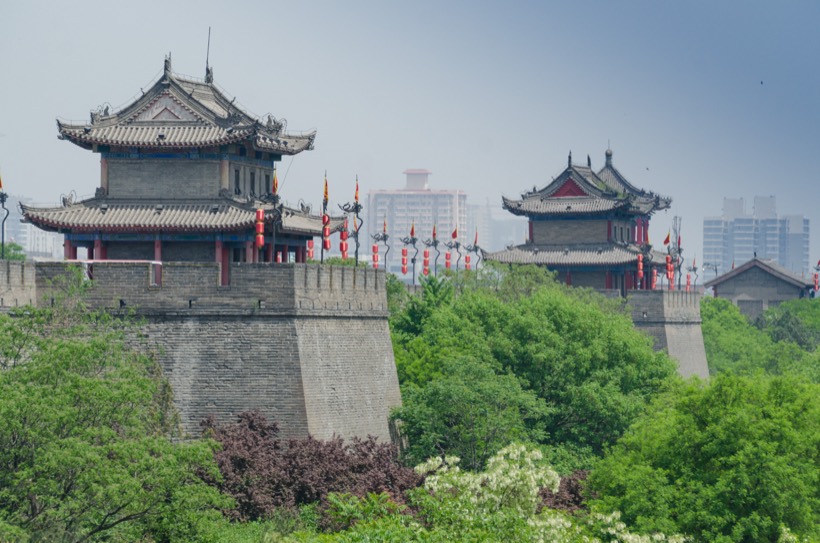
Xi'an Old City 西安古城
Cycle the most complete city wall in China, then eat your way through a Muslim quarter that has been here for 1,300 years.
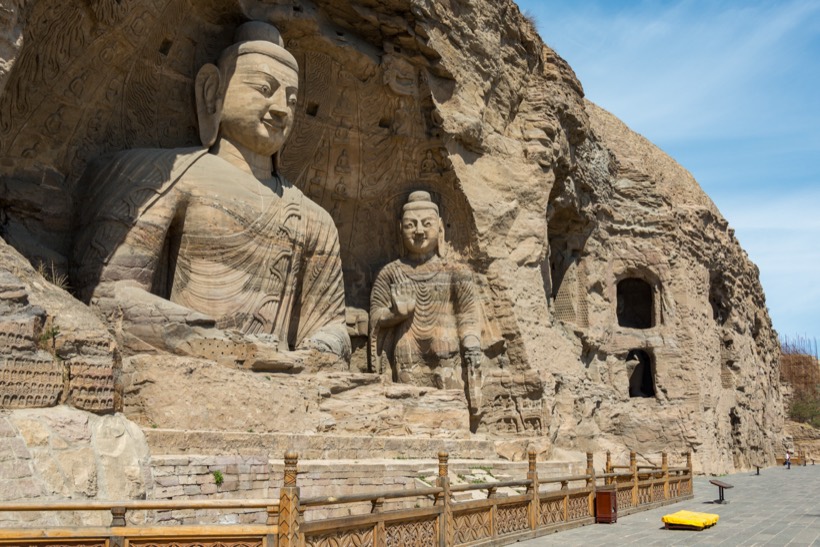 UNESCO
Yungang Grottoes & Datong 云冈石窟
Fifty-one thousand Buddhist statues carved into a sandstone cliff in the 460s, when the idea was still arriving from India.