Jiuzhaigou Valley
九寨沟 · Jiǔzhàigōu
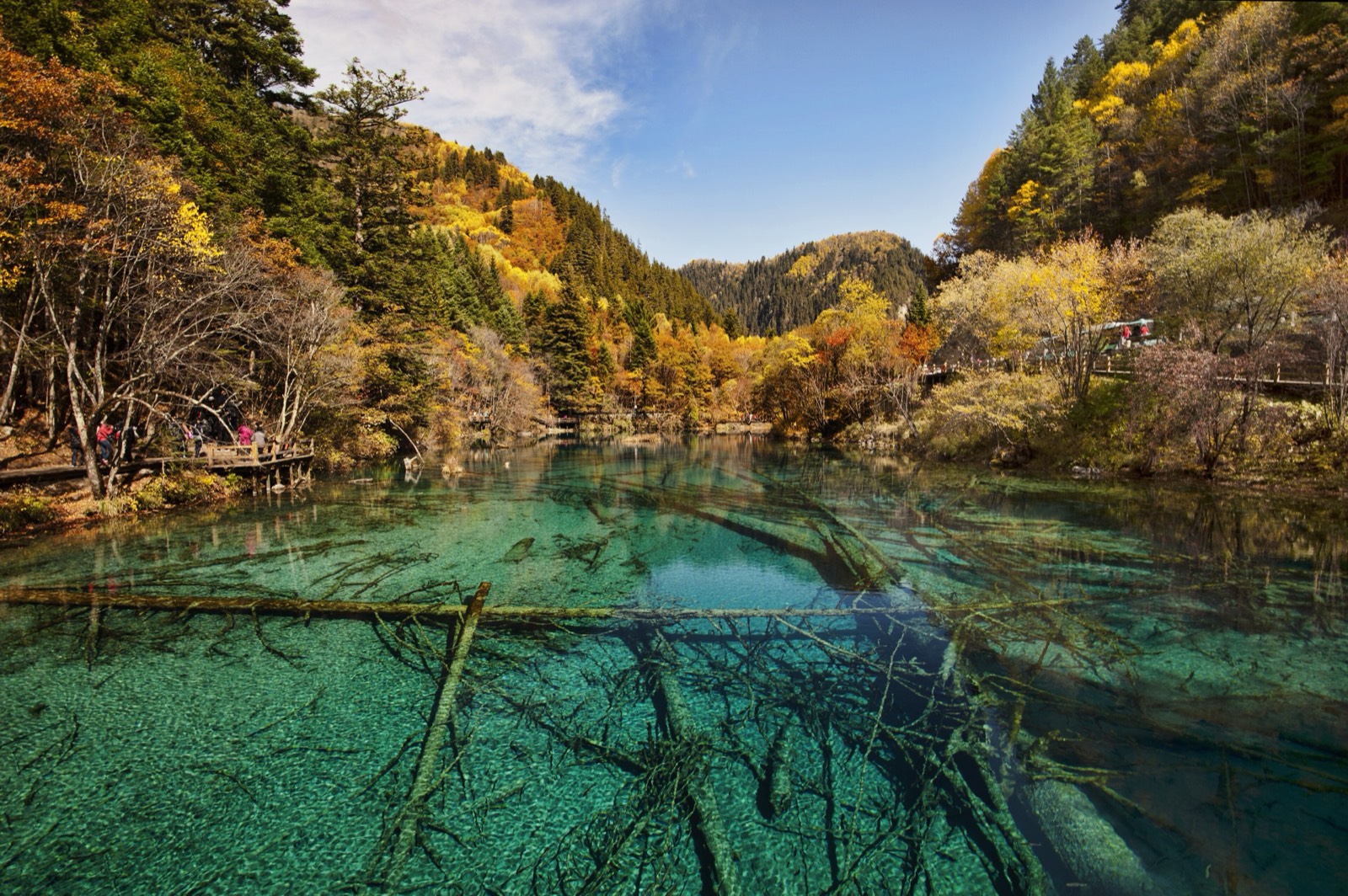
A hundred and eight lakes in calcium-carbonate blue, stacked down a Y-shaped valley below the Tibetan plateau.
Photo: Chensiyuan · CC BY-SA 4.0 · resized
Jiuzhaigou — 'nine village valley', for the Tibetan settlements in it — is a 72,000-hectare nature reserve on the eastern edge of the Tibetan plateau, ranging from 2,000 to 4,500 metres. What makes it extraordinary is water chemistry. The streams run through limestone and pick up dissolved calcium carbonate, which precipitates out as travertine, forming natural dams, terraces and lake beds. Because the water is exceptionally clear and the beds are pale, the lakes take on colours — turquoise, cobalt, emerald, a green that photographs as though it has been oversaturated — that are genuinely, verifiably real.
The valley is Y-shaped: a main entrance stem splitting into the Rize and Zechawa arms, with a shuttle-bus road running up each. The standard method is to take the bus to the top of one arm and walk down the boardwalk trails, catching buses to skip the dull sections. Doing that properly takes a full day; two days lets you cover both arms without rushing.
In August 2017 a magnitude 7.0 earthquake struck the valley, killing 25 people, destroying part of Sparkling Lake's dam and closing the park. It reopened in stages from 2019 with capped daily numbers and some areas permanently altered. It is still one of the most beautiful places in China.
Why go
- Lake colour that has to be seen to be believed, and it is not enhanced
- October, when the surrounding forest turns and reflects in the water, is spectacular
- Tibetan villages and prayer flags at the head of the valley
- Huanglong, an hour away, has terraced travertine pools that are just as strange
Highlights
Five Flower Lake
The signature: a shallow lake over fallen tree trunks, coloured in bands from yellow-green to deep blue. Best from the upper viewpoint at mid-morning.
Nuorilang Falls
320 m wide, the widest travertine waterfall in China, and the junction point of the valley's two arms.
Long Lake & Five Colour Pool
At the top of the Zechawa arm at 3,100 m — the deepest lake in the park, with a small intensely coloured pool below it.
Rize valley boardwalks
Panda Lake, Arrow Bamboo Lake, Mirror Lake and the Pearl Shoal cascades. The best continuous walking in the park.
Huanglong
An hour away over a 3,900 m pass: 3,400 travertine pools in gold-rimmed terraces up a mountainside. Higher, harder, and worth the altitude.
Photographs
Getting there & practicalities
Getting there
Jiuzhai Huanglong airport (3,450 m) is 90 minutes from the park, with flights from Chengdu, Chongqing and Xi'an. By road from Chengdu is 8–10 hours on mountain highway. There is no rail link yet.
Tickets
¥190 April–mid-November, ¥80 in winter, plus ¥90 for the mandatory shuttle bus. Daily entry is capped at 41,000 and must be booked online in advance.
Opening hours
07:00–18:00 in high season; last shuttle up around 15:00.
Best time of day
Mid-October for autumn colour; late May for meltwater and rhododendrons. Winter freezes the falls into ice and the park is nearly empty.
What everyone gets wrong
- Book tickets the moment they release. Autumn slots sell out within hours.
- The airport is at 3,450 m and you land straight into it. Take the first day gently — altitude sickness here is common.
- Buses run up; you walk down. Never try to walk up — the boardwalks are one-way in practice and the distances are long.
- Photographers: overcast days are better than sunshine for lake colour. Polarising filter is essential.
- Huanglong is at 3,600 m at its top pool and is a genuine effort. Oxygen canisters are sold at the gate and are not a gimmick.
What to eat
- Tibetan yak butter tea and tsampa in the valley's villages
- Sichuan food in Zhangzha town outside the gate; the in-park food court is expensive and mediocre — bring lunch
→Combine it with