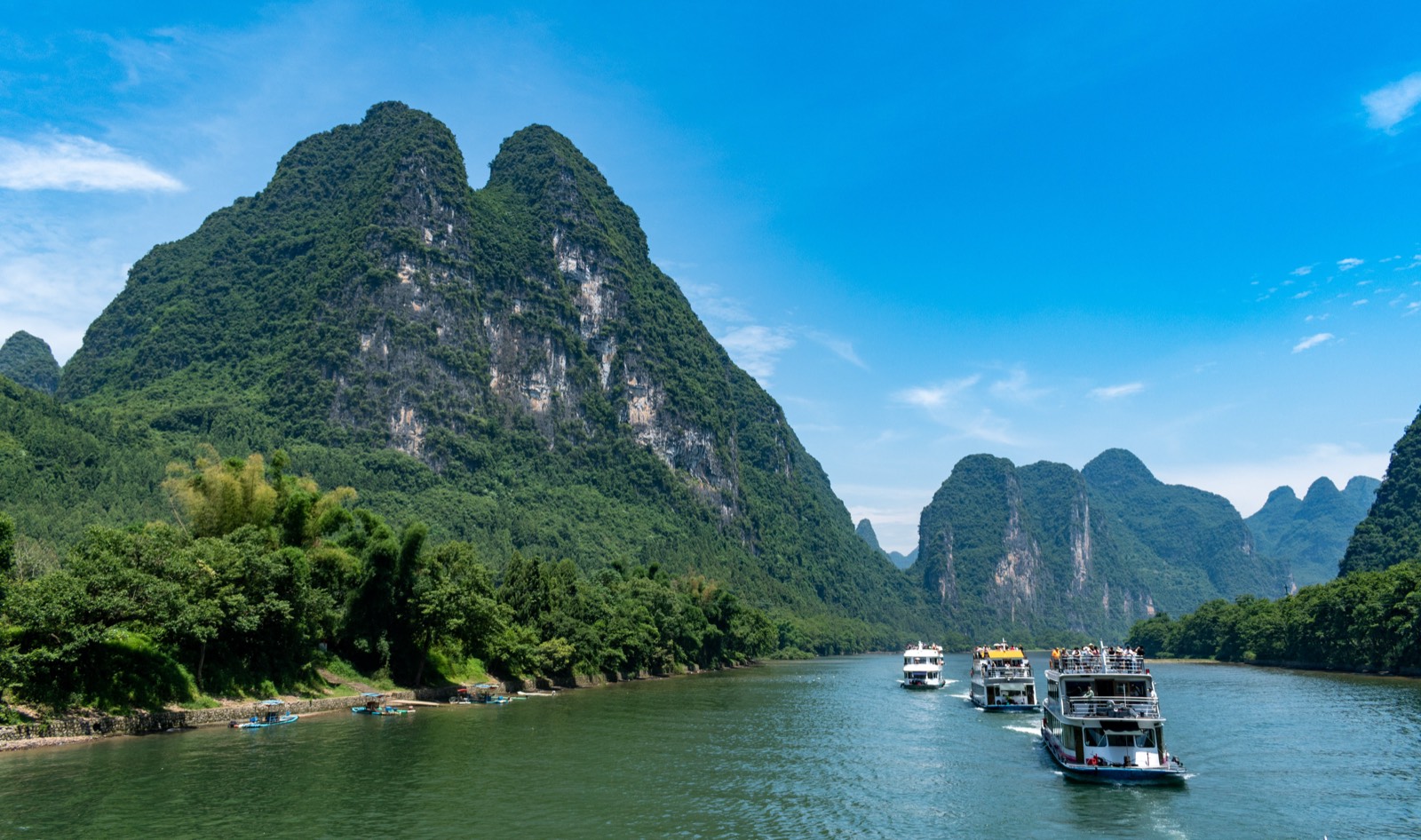
Li River & Yangshuo
漓江与阳朔 · Lí Jiāng & Yángshuò
The scenery on the back of the ¥20 note: limestone towers, bamboo, water buffalo and a river that bends between them for 83 kilometres.
Photo: xiquinhosilva · CC BY 2.0 · resized
The karst plain around Guilin is what happens when 200 million years of rain works on a limestone seabed. The rock dissolves along fractures until what is left standing are isolated conical and tower karst peaks — thousands of them, 100 to 200 metres high, rising straight out of flat paddy fields with no foothills at all. It is the landscape of every Chinese scroll painting, and the reason is straightforward: painters came here.
The classic experience is the river cruise from Guilin to Yangshuo — four and a half hours down 83 km of the Li, past Elephant Trunk Hill, the Nine Horses Fresco Cliff, and the exact bend at Xingping that appears on the ¥20 note. Cormorant fishermen still work the shallows, though these days largely for photographers. It is beautiful, slow and, on a big boat, quite crowded.
The better plan is to base yourself in Yangshuo, not Guilin. Guilin is a mid-sized Chinese city with some nice hills in it; Yangshuo is a small town in the middle of the karst with a cycling and climbing culture, a river you can raft in sections, and countryside — the Yulong River valley especially — that is more beautiful than the main Li and almost free of tour boats.
Why go
- The single most iconic landscape in China and it holds up completely
- Cycling the Yulong valley is the best day of many people's China trip
- China's best rock climbing, with 1,000+ bolted routes on the karst
- Longji rice terraces are two hours north, making an outstanding four-day Guangxi loop
Highlights
Li River cruise
Guilin to Yangshuo, 4.5 hours. Four-star boats ¥450 including lunch. Sit on the top deck and on the right side leaving Guilin.
Xingping & the ¥20 view
A small old town two-thirds down the river. Walk 25 minutes upstream to the marked viewpoint, take out a ¥20 note, and compare. Sunset is the time.
Yulong River bamboo rafts
A tributary with no motorboats — two-person bamboo rafts poled through low weirs between karst peaks. ¥240 for the full run, and better than the main river.
Cycling the Yulong valley
Rent a bike or e-bike in Yangshuo and ride the west bank of the Yulong through villages, past Dragon Bridge and Moon Hill. A full, flat, gorgeous day.
Moon Hill
A karst peak with a natural arch through it, 800 steps up, and a panorama over the whole valley from the top.
Impression Sanjie Liu
Zhang Yimou's outdoor night show staged on the Li River itself with 600 performers and the karst peaks as the set. Kitsch and spectacular.
Photographs
Getting there & practicalities
Getting there
Guilin North station: 3h from Guangzhou, 2h30 from Shenzhen, 10h from Shanghai. Yangshuo has its own high-speed station (Yangshuo Station, actually in Xingping) 30 minutes from town. Guilin's airport has wide domestic connections.
Tickets
Li River cruise ¥360–450 depending on boat class. Yulong bamboo raft ¥240 for the full 4 km. Moon Hill ¥60. Impression Sanjie Liu ¥260 and up.
Opening hours
Cruises depart Guilin's Zhujiang pier between 09:00 and 10:30 only — it is a once-a-day decision.
Best time of day
April to May for green paddies and mist; September to November for clear skies and lower water. Summer brings floods that can suspend the cruise entirely.
What everyone gets wrong
- Base in Yangshuo, day-trip to Guilin if at all. Most people get this the wrong way round.
- The four-hour cruise ends in Yangshuo, so do it as your transfer, not a return trip.
- West Street in Yangshuo is a loud bar strip. Stay 2 km out in the countryside — there are excellent small hotels among the fields.
- The Yulong River rafts stop running when the water is high; check before you commit to a plan.
- For photographers: Xingping at sunrise, the Yulong at sunset, and Xianggong Hill for the aerial-looking overview.
What to eat
- Beer fish (pijiu yu) — river fish braised with beer, tomato and chilli, the Yangshuo speciality
- Guilin rice noodles (mifen) with pickles and fried peanuts, eaten for breakfast
- Stuffed Li River snails and stuffed peppers, the local niang dishes