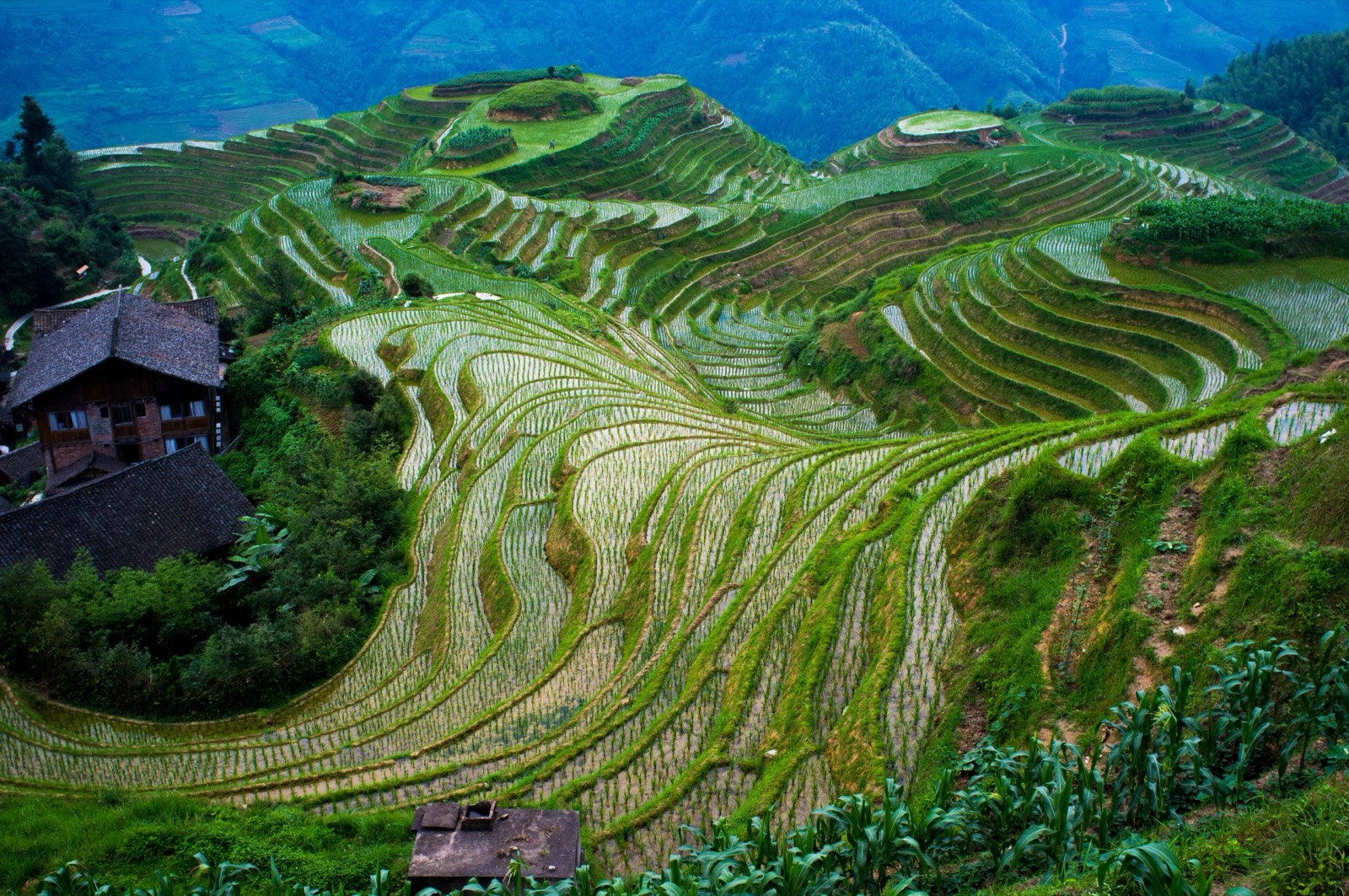
Longji Rice Terraces
龙脊梯田 · Lóngjǐ Tītián
Seven hundred years of hand-cut terracing wrapped around whole mountains, from riverbank at 300 m to ridge at 1,100 m.
Photo: severin.stalder · CC BY-SA 3.0 · resized
The Zhuang and Yao people began terracing these slopes in the Yuan dynasty and did not stop until the Qing. The result — Longji, 'dragon's backbone' — is around 66 km² of stepped paddy following every contour of the mountains, with terraces sometimes only a metre wide, all of it built and still worked by hand because no machine can operate on a 50-degree slope.
The landscape changes completely with the season, and choosing when to go matters more here than almost anywhere else in this guide. Mid-April to early June the terraces are flooded for transplanting and become a staircase of mirrors reflecting the sky — the most photographed state. Through summer they are solid green. From mid-September to mid-October they turn gold before the harvest, which is the other peak. In winter they are brown stubble, occasionally snow-dusted, and empty of tourists.
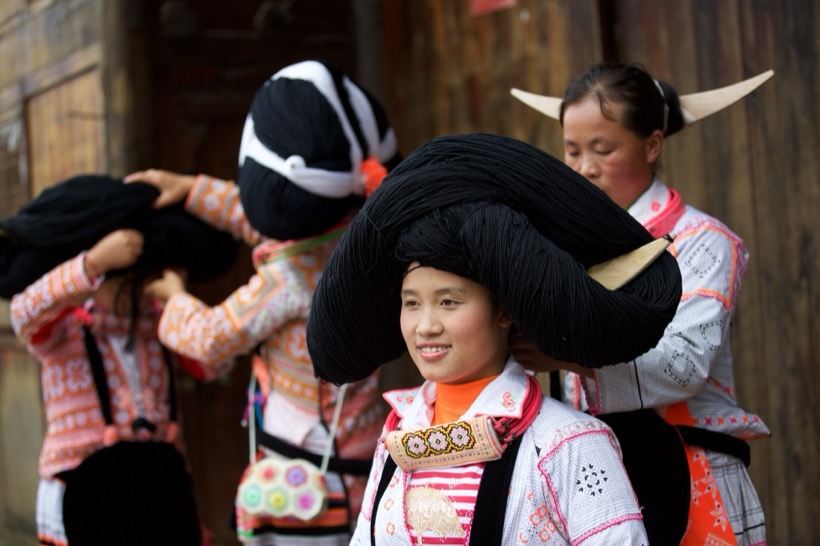
There are two main village clusters. Ping'an, in the Zhuang area, is closer, easier and more developed. Dazhai / Jinkeng, in the Yao area, is bigger, steeper and more spectacular, with three numbered viewpoints and a cable car. The Yao women of Huangluo village nearby have a well-known custom of cutting their hair only once in their lives, and keeping it — some of it reaches 1.7 metres.
Why go
- The most dramatic agricultural landscape in China, and it is still farmed rather than staged
- Village guesthouses in wooden stilt houses with terrace views from the balcony
- Real Zhuang and Yao minority culture within two hours of Guilin
- Excellent walking — a 3–4 hour ridge trail links Ping'an and Dazhai
Highlights
Jinkeng / Dazhai viewpoints
Three numbered platforms: No.1 (West Hill Music) for sunset, No.2 (Thousand Layers) for the classic overview, No.3 (Golden Buddha Peak) reached by cable car for sunrise.
Ping'an: Seven Stars & Nine Dragons
The two classic viewpoints above Ping'an village, 30–45 minutes' climb from the guesthouses. Easier than Jinkeng and still superb.
The Ping'an–Dazhai ridge walk
Three to four hours over the ridge between the two areas, through Zhongliu village. The best walking in the region and mostly empty.
Huangluo Yao village
The long-hair village, at the foot of the valley. The performance is staged but the custom is real.
Sunrise from Golden Buddha Peak
Cloud sitting in the valleys below the terraces at first light. This is the shot.
Photographs
Getting there & practicalities
Getting there
Buses from Guilin's Qintan or Langdong stations to Longsheng, then a local bus up (2.5–3h total). Direct tourist shuttles run from Guilin and Yangshuo for ¥60–80. From the ticket gate a village minibus takes you to Ping'an or Dazhai; the final stretch to your guesthouse is on foot or by porter.
Tickets
¥80, covering both Ping'an and Jinkeng areas. Jinkeng cable car ¥55 one way, ¥100 return.
Opening hours
Terraces are open landscape; the cable car runs roughly 07:30–17:30.
Best time of day
Mid-May for flooded mirrors; late September to mid-October for gold. Sunrise and the hour before sunset for light.
What everyone gets wrong
- Stay overnight in a village. Day trips from Guilin arrive at the worst light and leave before the best.
- Guesthouses are up steps — sometimes many. Ask about the walk from the drop-off when you book, and pack light.
- Jinkeng is more impressive; Ping'an is easier and better for a short stay. If you have two nights, do one of each.
- The exact harvest date shifts by a week or two each year. Check recent photos before locking in a golden-terrace trip.
- Local women will offer to carry your bag for ¥30–50. It is a fair price for a hard job.
What to eat
- Bamboo-tube rice and chicken cooked in a bamboo section over the fire
- Longji glutinous rice wine, and smoked pork from the rafters of the guesthouse kitchen
→Combine it with
Nearby and next
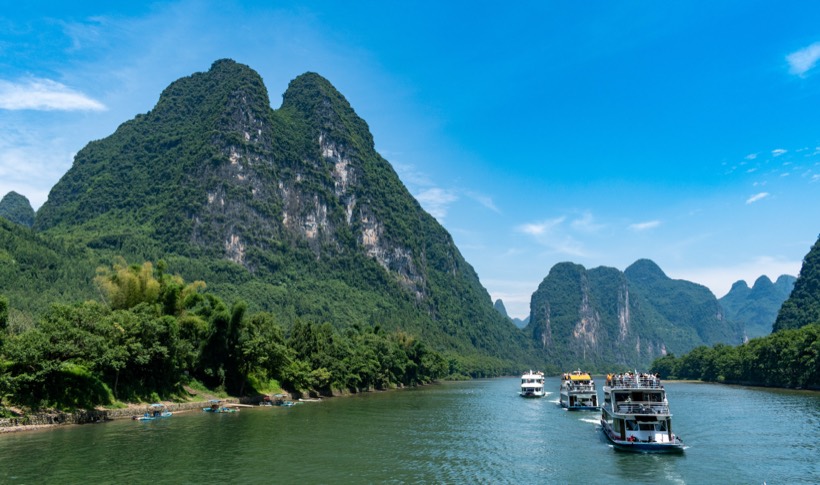
Li River & Yangshuo 漓江与阳朔
The scenery on the back of the ¥20 note: limestone towers, bamboo, water buffalo and a river that bends between them for 83 kilometres.
Guizhou: Miao & Dong Country 贵州苗侗村寨
Hillside villages of a thousand stilt houses, silver headdresses weighing ten kilos, and drum towers built without a single nail.